

Most people think digital forms are simple.
A few fields. A submit button. Done.
But when forms are used in high-impact public services, where accuracy, timing, and trust matter, the difference between a “working” form and a well-designed digital experience can directly affect outcomes.
At Armely, we’ve spent time studying and designing complex, multi-step public-sector intake workflows. What we’ve learned is this:
Great digital forms don’t just collect data. They guide people through difficult moments with clarity, safety, and confidence.
Why High-Impact Forms Are Fundamentally Different
In many public-sector scenarios, users are:
- Under stress
- Providing sensitive information
- Unfamiliar with legal or administrative language
- Using mobile devices or shared computers
This means traditional “flat” forms fail quickly.
Instead, these experiences behave more like decision-driven journeys than static questionnaires.
A single answer can:
- Trigger additional required questions
- Change eligibility paths
- Alter what information must be collected next
- Affect downstream reviews or approvals
Designing for this reality requires more than UI skills, it requires systems thinking.
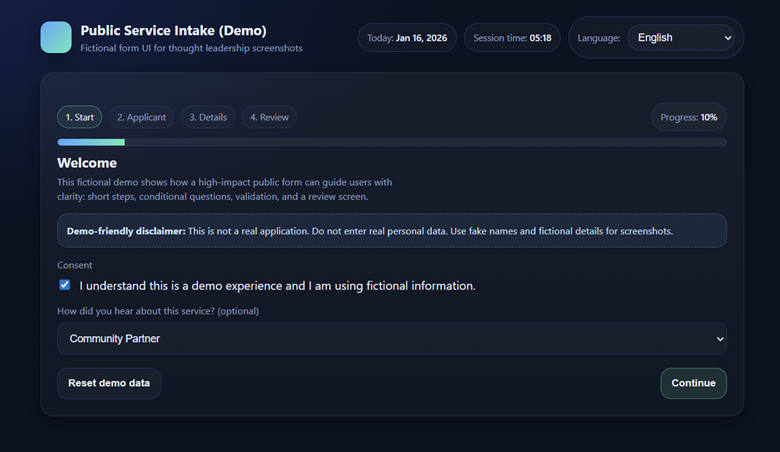
Progressive Design Reduces Cognitive Load
One of the most effective strategies in complex digital workflows is progressive disclosure.
Rather than presenting dozens of fields at once:
- Information is grouped into logical steps
- Progress indicators help users understand where they are
- Only relevant questions appear at the right moment
This approach:
- Reduces abandonment
- Improves data quality
- Builds trust by making the process feel manageable
Progress isn’t just a visual cue,it’s reassurance.

Time Awareness Without Creating Pressure
Some public-sector workflows require awareness of session time for auditing or compliance.
However, urgency must be handled carefully.
Well-designed systems:
- Track time silently in the background
- Provide gentle reminders instead of hard cutoffs
- Support autosave and safe continuation
The goal is accountability without increasing anxiety.

Conditional Logic Should Feel Invisible
Users should never feel like the system is “testing” them.
Smart conditional logic allows:
- Relevant follow-up questions to appear naturally
- Irrelevant sections to stay hidden
- The experience to feel responsive, not rigid
When done correctly, users don’t notice the logic, they just feel guided.

Data Integrity Is a Trust Issue
High-impact forms often collect:
- Personal identifiers
- Demographic information
- Contact details
- Sensitive contextual data
Handling this information responsibly means:
- Validating inputs early
- Structuring data for downstream use
- Separating identity data from process metadata
- Designing with privacy and security from the start
Trust isn’t declared; it’s designed.
Accessibility Is Core, Not Optional
Digital public services must work for everyone.
That includes:
- Screen readers and assistive technologies
- Multilingual users
- Users with visual, auditory, or motor impairments
- People accessing services on low-bandwidth connections
Accessibility isn’t just compliance, it’s inclusion.
When accessibility is built in from day one, everyone benefits.

From Digitization to Digital Transformation
Simply moving a paper process online is not transformation.
True digital transformation:
- Re-thinks the user journey
- Reduces friction at every step
- Improves accuracy and completion rates
- Aligns technology with human behavior
High-impact digital forms are not “just forms.”
They are critical infrastructure for public trust.

How Armely Approaches Complex Digital Workflows
At Armely, we design digital solutions with one principle in mind:
If a system works technically but fails the person using it, it hasn’t succeeded.
Our approach combines:
- Human-centered design
- Strong data architecture
- Secure, compliant engineering
- Deep understanding of public-sector realities
The result is technology that quietly works in the background, so people can focus on what matters.
Let’s Build Digital Experiences That Actually Work
If you’re modernizing complex forms, intake systems, or public-facing workflows, Armely can help you design solutions that are clear, secure, and human-centered.
Because in high-impact environments, good design isn’t optional, it’s essential.